Travel and Expense
From Travel Transactions to Organizational Memory: The Next T&E Frontier
For two decades, organizations have pursued the same goals in travel and expense: digitize booking, automate expense reports, and streamline approvals. Those capabilities are now expected. According to IDC's Enterprise Application Agent Strategies Survey, 66.1% of organizations are already using AI-enabled applications or automation. The question is no longer whether to adopt these tools — it's how to drive value from them. The organizations pulling ahead are no longer asking how to automate their T&E. They are asking how to learn from it.
The Travel & Expense Automation Era Is Maturing. What Comes Next?
Automation will remain important. So will compliance, usability, integration, and cost. But IDC's research is clear: these capabilities are increasingly becoming the foundation, not the destination.
As AI becomes commonplace across enterprise software, model availability alone will provide less differentiation. IDC's whitepaper "From Fragmented Spend to Smarter Business Decisions" makes the point plainly: better AI alone does not guarantee better decisions. AI needs context. The organizations that will get the most from AI-powered T&E platforms are those that give their AI the richest, most connected information to work with — and that starts with how travel, expense, and TMC services are connected to each other.
Why Organizational Memory Changes the T&E Equation
IDC introduces a concept that reframes how we should think about travel and expense data: organizational memory. The distinction is simple but significant. Data tells the organization what happened. Context helps it understand why. Organizational memory ensures what it learned can influence what happens next.
Every employee journey generates information about traveler behavior, supplier performance, policy effectiveness, operational disruptions, and financial outcomes. Most organizations automate the transactions. Far fewer integrate the surrounding servicing and support data—the interactions that expose traveler friction, supplier issues, and behavioral patterns—into the same system.
Without that connection, organizational memory remains incomplete. One employee encounters a problem with a supplier; it gets resolved, processed, and forgotten. Weeks later, another employee encounters the same problem. The enterprise has to relearn lessons it has already paid to learn.
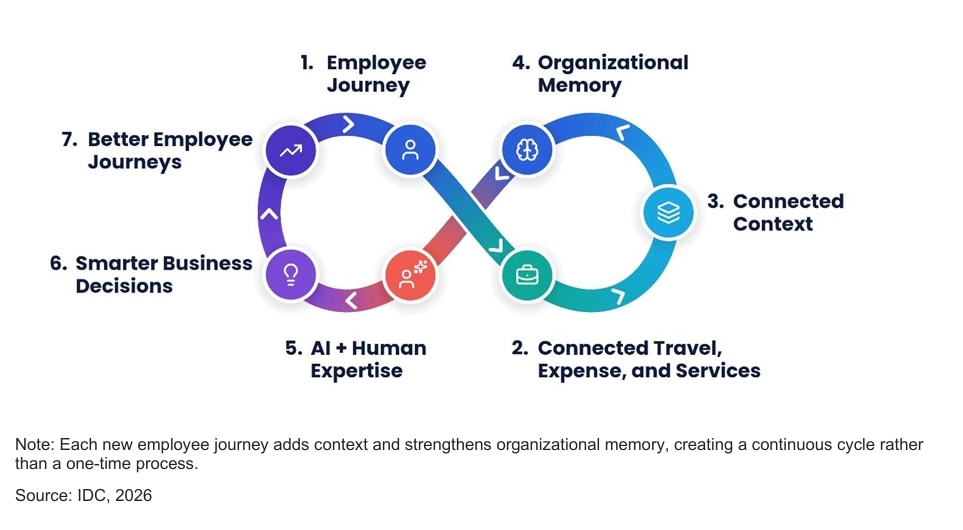
The Role of Connected Travel & Expense Context in Smarter Decision-Making
The problem, IDC argues, is rarely a lack of information, it’s that no one sees the entire picture. Travel systems know where employees went. Expense systems know what they spent. Support teams know where travelers struggled. Finance understands reimbursement. Each function holds a piece of the story. Connecting those pieces remains the challenge — and a significant one. IDC research identifies data quality and readiness as the second most frequently cited barrier to becoming an autonomous business, flagged by 40.9% of organizations.
Connected context goes beyond aggregating data. It means understanding a travel or expense event alongside the decisions, behaviors, policies, supplier interactions, and outcomes surrounding it. That distinction matters more as organizations move from reporting on what happened to deciding what should happen next. The IDC research revealed that today, only 25.9% of organizations can make decisions in real time or near real time. The gap between data and decision remains wide — and connected T&E is one of the most direct ways to close it.

From fragmented spend to smarter business decisions
Most companies are great at recording travel. Far fewer actually learn from it. IDC's latest research shows what's missing — and what to do about it.
What Integrated Travel, Expense, and Servicing Looks Like in Practice
Complete by SAP Concur and Amex GBT illustrates this evolution through integrated travel and expense management, connected ecosystem data, embedded AI, TMC services, traveler support, financial visibility, and supplier connectivity. The value of bringing these capabilities together is not simply greater automation; it is continuity.
Information generated during booking does not remain isolated from expense management. Expense patterns can inform policy. Support interactions reveal traveler friction. Supplier performance influences future decisions. Amex GBT's TMC expertise adds interpretation. AI applies that context at greater speed and scale.
The foundation Complete is built upon comes with a proven track record. The Concur Travel & Expense platform has delivered a 406% three-year ROI and $1.6M in average annual savings for organizations using it — a base Complete extends with connected booking, servicing, and TMC capabilities. Amex GBT's travel network reaches nearly 140 countries, backed by a 95% customer retention rate and $36 billion in annual travel transactions.
How Finance Leaders and Travel Managers Can Start Building Toward A More Connected T&E Model
IDC's guidance for organizations moving in this direction is practical: connect journeys, not just systems. Here’s what this looks like in practice:
- Look for solutions that create continuity across travel, expense, financial operations, and TMC services so that each experience can improve the next.
- Treat TMC expertise as part of the technology strategy, not a separate service layer.
- Build for learning, not simply reporting. And measure better decisions — policy outcomes, supplier relationships, decision quality — not just faster processes.
For finance leaders and travel managers evaluating where to start, the IDC whitepaper "From Fragmented Spend to Smarter Business Decisions" provides the strategic foundation. The analysis comparing Complete with Navan and Spotnana offers a practical framework for evaluating platforms. And the Complete solution brief shows how these principles translate into a connected T&E experience organizations can build today.
Frequently Asked Questions
What is organizational memory in travel and expense?
IDC defines organizational memory as accumulated knowledge that an organization can apply to improve decisions over time. In a T&E context, it means the lessons learned from each employee journey — about suppliers, traveler behavior, policy effectiveness, and financial outcomes — are retained and made available to future decisions, rather than disappearing when the process ends.
Why does AI need connected travel and expense data to work effectively?
AI recommendations are only as good as the context behind them. When travel, expense, and support data are fragmented across separate systems, AI has access to individual transactions but not the patterns, behaviors, and outcomes that give those transactions meaning. IDC research identifies data quality and readiness as a key barrier to autonomous decision-making for 40.9% of organizations — a challenge connected T&E directly addresses.
How does connected travel and expense management create organizational memory?
When booking, traveler support, and expense share a common data foundation, information from each employee journey — support interactions, policy exceptions, supplier encounters, spending patterns — remains available to inform future decisions. Over time, this creates a feedback loop where each journey makes the next one better informed. That accumulation of applied knowledge is what IDC calls organizational memory.
How should finance leaders evaluate T&E platforms for connected context?
Look beyond automation rates and feature checklists. Evaluate whether the platform connects data across booking, support, and expense; how it handles off-tool bookings; its integration ecosystem; and whether TMC services are part of the same data environment or a separate layer. IDC recommends measuring decision quality, policy outcomes, and supplier relationship improvements — not just processing speed.