Control Company Costs
How to calculate cash flow for your business
Cash flow is one of the most telling metrics for business success. Knowing how to calculate it can keep your company in the green for years to come. Here’s how to do it and why it’s so important for any business.
What is cash flow and why does it matter?
Cash flow refers to the movement of money in and out of a business. Monitoring your cash flow is an important way to keep tabs on your company’s financial health. For example, if more money is going out than coming in, that’s a sign your company’s financial stability is at risk. You can then use that information as a guide in decision making moving forward.
Cash flow is imperative for transparency and accountability. It is often required for compliance purposes within loan agreements or with public investors, and is especially important if you plan to sell your company in the future, as it’s often used to help set the valuation of your business.
The three types of cash flow
In looking at your business cash flow statement, you will find three types of cash flow:
Operating cash flow
Cash coming in or out as a result of running your business. This refers to inflows like revenue, including sales revenue and interest income, and cash outflows like employee salaries, taxes, supplier and vendor payments, and other operating expenses.
Investing cash flow
Cash coming in or out from selling or buying investments and other assets. These are inflows like proceeds from the sale of property, equipment, or investments, and outflows from activities like acquisitions, investments, and other capital expenditures, such as purchases of fixed assets (new equipment or facilities).
Financing cash flow
Financing activities, including debt and equity. These include inflows like proceeds from issuing stock or borrowing from lenders, and outflows like dividend payments, stock buy-backs, or loan repayments.
Cash Flow Calculation Methods: Direct, Indirect & Free
You can calculate your cash flow and present a cash flow statement in a few different ways.
Direct method
This method directly lists all the cash coming in and going out as a result of business operations. These are things like cash received from customers, cash paid to employees, cash paid to suppliers, and cash paid for interest and taxes. It shows real cash transactions to arrive at a company’s net cash from operating activities, which gives a more transparent view of cash flow.
Indirect method
This method uses accrual accounting information, starting with your net income and then adjusting for the non-cash items. This is done by adding back any expenses like depreciation and amortization, and adjusts for changes to your working capital, including accounts payable, accounts receivable, and inventory.
Free cash flow
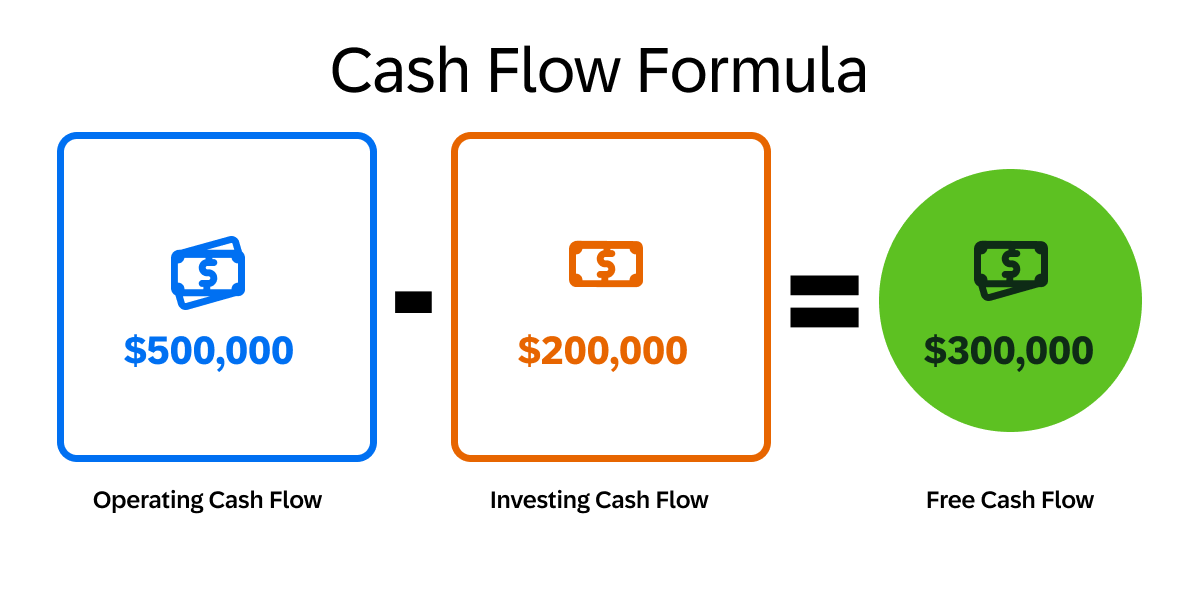
Free cash flow is the money a company has left after accounting for capital expenditures. It represents the available cash a company can use for things like reducing debt, reinvesting in the business, paying dividends to shareholders, or building up cash reserves. Free cash flow focuses on actual cash, making it a key indicator of a company’s financial health and flexibility. It can be calculated by subtracting capital expenditures from operating cash flow. It would look something like this:
Common cash flow mistakes
Failing to closely monitor cash flow is a substantial mistake a company can make. It can happen during periods of rapid growth where a business sees high profits and focuses more on revenue, or when it encounters surprise costs due to expansion. It can also occur when client payments are delayed or bills are not paid on time. This is why consistently evaluating your finances and accounts payable processes, as well as looking at 30-, 60-, and 90-day projections, can help you address and prevent any potential bottlenecks.
Another common mistake is relying on a single cash flow to run a business. For smaller and midsize businesses, diversifying products or service offerings might feel overwhelming or complicated, especially if staff is already stretched thin. However, having more than one revenue stream helps keep a company afloat during slow periods and other tough times, like losing a big client or navigating external socioeconomic or political factors outside their control.
How travel and expense impacts cash flow
Travel and expense (T&E) has a direct impact on company cash flow. Any time an employee books a flight or hotel, takes a taxi or rideshare, or purchases meals while on the road, they reduce the company’s available cash. These direct cash outflows can become unpredictable if the employee submits their expense report late, or the end-to-end expense process is inefficient, making it difficult for the company to forecast and budget accordingly.
Plus, if the company lacks proper compliance safeguards like spending limits and other T&E policies, what was supposed to be a simple business trip can turn into a high-cost direct cash outflow. On top of that, weak or nonexistent policy enforcement can also enable fraud, making it easier for duplicative or inflated claims to slip through the cracks. The more these instances are missed, the more leakage occurs over time. However, the more visibility there is, the more control a company has over its cash flow.
How spend automation improves cash flow visibility
Disjointed solutions and manual processes don’t provide clean data or accessible reporting, two things a business needs in order to make informed decisions. Spend management automation, on the other hand, can enhance visibility across your entire cash flow by bringing all your spend information into one place. With an automated platform, you can:
- Improve compliance: Let AI automatically review every expense against policies and flag items that need your attention.
- Stay organized: Provide an audit trail for sustainability requirements, tax regulations, fraud prevention, and budget management.
- Enhance invoicing: Automate capture, matching, routing, and approval workflows to reduce errors and improve visibility.
- Simplify taxes: Tackle complex tax challenges like VAT and taxable employee benefits to bring money back to your budget and ensure compliance.
Calculating your cash flow is one of the best ways to know exactly how your business is doing. Talk to an SAP Concur expert to learn how our solutions provide the comprehensive visibility you need to make the best decisions for your business.